What Is The Difference Between Large Cap, mid-cap, and small-cap funds?
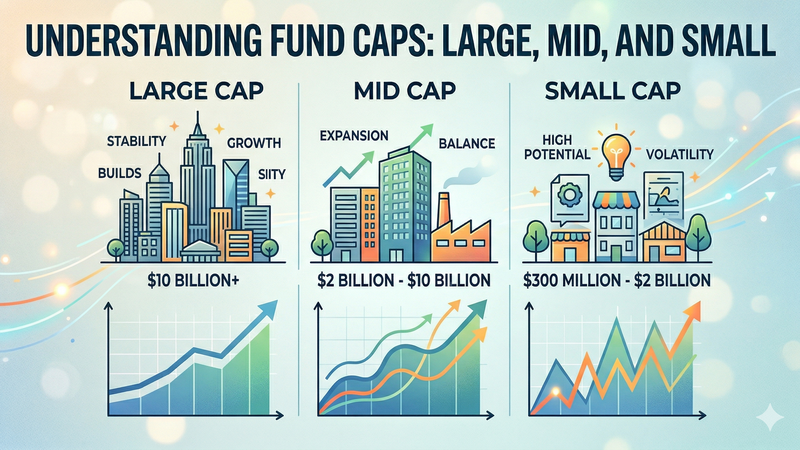
Most investors have heard terms like large-cap, mid-cap, and small-cap funds. But many are unsure what these categories actually mean or how they affect risk and returns. Is small-cap always better for higher returns? Are large-cap funds safer? Where do mid-cap funds fit in?
The answer lies in understanding market capitalization. Market capitalization refers to the total market value of a company’s outstanding shares. It helps classify companies by size, which directly influences their growth potential, stability, and risk levels.
Before investing, it is important to understand the large-cap, mid-cap, and small-cap categories clearly. The difference between small-cap, mid-cap, and large-cap funds is not just about company size. It also affects volatility, return expectations, and suitability for different types of investors.
In this article, we will break down the difference between these categories, compare their features, and help you understand who should consider investing in each.
What Does Market Capitalization Mean?
Market capitalization, commonly called market cap, refers to the total market value of a company’s outstanding shares. It shows the company's market value at a given point in time.
Market cap is calculated using a simple formula:
Market Capitalization = Share Price × Total Number of Outstanding Shares
For example, if a company’s share price is ₹500 and it has 10 crore outstanding shares, its market capitalization would be ₹5,000 crore.
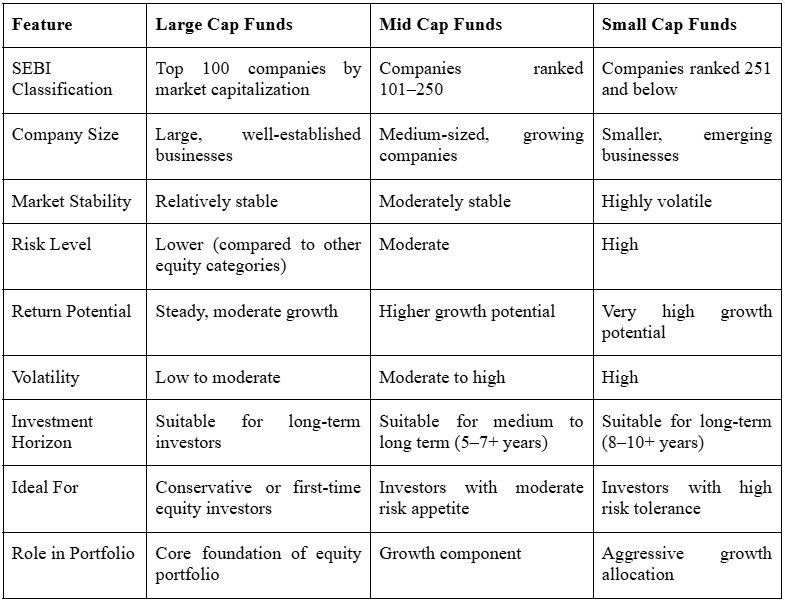
Market capitalization is important because it helps classify companies into different categories, such as large-cap, mid-cap, and small-cap. As per SEBI guidelines in India, the top 100 companies by market capitalization are classified as large-cap, companies ranked 101 to 250 are mid-cap, and those ranked 251 and below are small-cap.
Market cap does not reflect a company's profitability. Instead, it reflects the company’s size and market value. Larger companies generally have more stable operations, while smaller companies may have higher growth potential but also higher volatility.
For a deeper understanding of how equity funds compare with other asset classes, you can also read this detailed guide on the difference between equity and debt mutual funds.
What Are Large Cap Funds?
Large-cap funds are mutual funds that invest primarily in the top 100 companies by market capitalisation, as defined by SEBI. Market capitalisation refers to the total value of a company’s outstanding shares in the stock market. These companies are typically well-established businesses with a strong market presence and long operating history. As per regulations, large-cap funds must allocate at least 80% of their assets to these top-ranked companies.
Characteristics
Large-cap funds focus on financially stable, industry-leading companies. These businesses usually have consistent revenue streams, strong balance sheets, and a proven track record of performance. The portfolio generally includes blue-chip stocks that are widely tracked and actively traded on stock exchanges.
Risk Level
Compared to other equity categories, large-cap funds tend to have lower volatility. Established companies are often better positioned to withstand economic slowdowns. However, they are still subject to market risks, as their returns depend on overall stock market movements.
Return Potential
Large-cap funds may not generate high short-term gains, but they have historically delivered steady long-term returns. Their growth is typically moderate and more consistent than in the small-, mid-, and large-cap categories, where smaller companies may show sharper fluctuations.
Examples
- SBI Bluechip Fund
- ICICI Prudential Bluechip Fund
- HDFC Top 100 Fund
- Axis Bluechip Fund
- Mirae Asset Large Cap Fund
- Kotak Bluechip Fund
- Nippon India Large Cap Fund
- UTI Large Cap Fund
What Are Mid-Cap Funds?
Mid-cap funds are mutual funds that invest primarily in mid-sized companies. These companies fall between large-cap and small-cap firms in terms of market capitalisation. Globally, mid-cap companies are often defined as those with a market value between $2 billion and $10 billion. In India, as per SEBI classification, mid-cap companies are ranked 101-250 by full market capitalisation. Mid-cap funds must invest at least 65% of their assets in these companies.
Characteristics
Mid-cap companies are typically in a growth phase. They are more established than small companies but still have room to expand, unlike large-cap firms. Many of these businesses have already built a strong presence in their industries and are working to further scale operations. Mid-cap funds offer diversification by investing across multiple mid-cap companies. They may be actively managed or passively track benchmark indices, such as the Nifty Midcap 150.
Risk Level
Mid-cap funds carry moderate risk. They tend to be more volatile than large-cap funds but generally less risky than small-cap funds. In the small-cap vs. mid-cap vs. large-cap comparison, mid-cap funds are often seen as a balance between growth and stability.
Return Potential
Mid-cap funds have the potential to generate higher returns than large-cap funds over the long term. Their growth prospects are stronger, though returns may fluctuate more during market cycles.
Examples
- HDFC Mid-Cap Opportunities Fund
- Kotak Emerging Equity Fund
- Axis Midcap Fund
- DSP Midcap Fund
- SBI Magnum Midcap Fund
- Nippon India Growth Fund
- Tata Midcap Growth Fund
- Edelweiss Mid Cap Fund
What Are Small-Cap Funds?
Small-cap funds are mutual funds that invest a major portion of their corpus in equity or equity-related instruments of small-cap companies. As per SEBI guidelines, small-cap funds must invest at least 65% of their total assets in small-cap stocks. SEBI classifies small-cap companies as those ranked below the 250th position by market capitalisation. In general terms, these are companies with relatively smaller market value and emerging business presence.
Characteristics
Small-cap companies are usually in the early stages of growth. They have significant expansion potential but limited financial history compared to large and mid-sized firms. Their stock prices are highly sensitive to market movements, meaning they can rise sharply during bull markets and fall sharply during bear markets. Because of this, small-cap funds are considered suitable for long-term investment horizons, typically 8 to 10 years.
Risk Level
Small-cap funds carry high risk. Even minor market volatility can cause large price swings. In the small-cap vs. mid-cap vs. large-cap comparison, small-cap funds are the most volatile. Short-term fluctuations can be sharp, and investors must be prepared for periods of underperformance. Considering the impact of inflation on everyday investments is equally important.
Return Potential
Small-cap funds offer high growth potential. If the underlying companies expand successfully, their stock prices can increase substantially. Over the long term, these funds may generate benchmark-beating returns, though performance can vary significantly across market cycles.
Examples
- SBI Small Cap Fund
- Nippon India Small Cap Fund
- HDFC Small Cap Fund
- Axis Small Cap Fund
- DSP Small Cap Fund
- Tata Small Cap Fund
- Kotak Small Cap Fund
- ICICI Prudential Smallcap Fund
Large Cap vs Mid Cap vs Small Cap: Key Differences
Taxation of Large Cap, Mid Cap, and Small Cap Funds
Since large-cap, mid-cap, and small-cap funds are all classified as equity mutual funds, the same capital gains tax rules apply across all three categories.
Short-Term Capital Gains (STCG)
If you redeem your fund units within 12 months of purchase, the profits are treated as Short-Term Capital Gains. As per Budget 2024, STCG on equity mutual funds is taxed at 20%, plus a 4% health and education cess on the tax amount.
Long-Term Capital Gains (LTCG)
If units are held for more than 12 months, the profits are classified as Long-Term Capital Gains. LTCG up to ₹1.25 lakh in a financial year is fully exempt from tax. Any gains above this threshold are taxed at 12.5%, plus applicable cess and surcharge. Previously, the LTCG rate was 10% with an exemption limit of ₹1 lakh per financial year.
These tax rules apply uniformly regardless of whether you are invested in a large-cap, mid-cap, or small-cap fund. The key factor determining your tax liability is simply how long you stay invested.
How FinAtoZ Simplifies Cap Fund Investing
At FinAtoZ, the focus is not just on selecting funds, but on building a structured financial plan that aligns with your life goals.
A certified adviser works with you in a one-on-one session to understand your current financial position. This helps quantify goals such as your child’s education, retirement planning, or long-term wealth creation. The idea is to define how much is needed clearly and by when.
Once the plan is created, a qualified investment team manages your portfolio in line with your risk profile. Fund selection and asset allocation are backed by research and adjusted based on market conditions and the time horizon for each goal.
FinAtoZ also conducts periodic reviews to ensure your plan stays aligned with life changes. Whether it is a new family member, a career shift, or changing financial priorities, your adviser updates the plan accordingly.
As a SEBI-registered investment adviser, FinAtoZ combines technology with personalized guidance. The secure online platform lets you track your financial journey anytime, while your investments are managed through a structured 5P Research Process.
Frequently Asked Questions
Is it better to invest in large-cap, mid-cap, or small-cap funds?
There is no single best category. The choice depends on your risk tolerance, investment horizon, and financial goals.
Can I invest in all three cap categories together?
Yes, many investors diversify across large-cap, mid-cap, and small-cap funds to balance stability and growth potential.
Are small-cap funds suitable for short-term investment?
Small-cap funds are generally more volatile and are better suited for long-term investors with higher risk tolerance.
Do mid-cap funds always give higher returns than large-cap funds?
Mid-cap funds have higher growth potential, but returns can vary based on market conditions and economic cycles.
How long should I stay invested in equity cap funds?
Equity investments are typically considered suitable for long-term horizons of 5 years or more, depending on the category.
Get Expert Financial Advice
Book an introductory call with our Certified Financial Planner to explore how we can help you achieve your financial goals.
Book Your Appointment

