Factors Affecting Investment Decisions: A Complete Guide to Investment Decision Making in Financial Management

Imagine a regular individual, Swati, whose life savings doubled overnight because she decided to invest in an under-the-radar mutual fund. On the flip side, there's Raj, who watched helplessly as his investment choices took a wrong turn, nearly halving his nest egg. These stories illustrate the power of investment decisions.
Did you know that only 3% of people invest in mutual funds? Also, out of these investors, some investors always seem to earn great returns, while some don't seem to break even. The answer lies in the investment decision taken. When it comes to striking the gold, every decision matters. Whether buying a stock or investing in a new real estate option, a single decision can be the reason for wealth creation or missed opportunities.
If you are serious about financial growth, then it is crucial to get serious about the decisions you make regarding your investments. In this article, we will explore what an investment decision is in financial management, the investment decision process, types, importance, and factors affecting investment decisions.
What is an Investment Decision?
In simple terms, an investment decision refers to your decision concerning where, when, and how much to invest to maximise returns. The decision involves allocating funds to various options, such as equities, bonds, real estate, or even business projects.
The process of making an investment decision involves:
- How much to invest?
- Which assets to buy?
- How long to stay invested?
It can come off as confusing; hence, having a professional financial advisor can be quite beneficial in making the right investment decision.
Importance of Investment Decision
Making the right investment decision, such as choosing the best mutual fund for your portfolio, can directly affect your financial security and wealth creation. A well-thought-out decision can increase returns, while a bad decision can lead to significant losses.
For instance, consider a scenario where a 1% increase in annual return on ₹10 lakh can grow to ₹27 lakh in 20 years, as opposed to just ₹24 lakh with the same initial investment but a lower return. These numbers clearly illustrate how critical investment decisions can be in shaping your financial trajectory.
Reasons why investment decisions matter:
- It ensures that funds are allocated efficiently
- It will help in maximising wealth
- It reduces risks with fund diversification
- It encourages portfolio management in a disciplined manner
- It helps to achieve financial goals
Types of Investment Decisions
It is important to understand that investment decisions are not one-size-fits-all. The investment decision will vary based on factors like the nature of funds, time horizon, and objectives. Investment decisions are classified as:
Capital Budgeting Decision
These are long-term investment decisions in fixed assets or business projects. An example is investing in a new venture.
Working Capital Decision
These decisions are mostly short-term investment decisions. Example: Managing cash balances, accounts receivable, etc.
Portfolio Investment Decisions
The decisions between stocks, bonds, ETFs, real estate, or mutual funds.
Factors Affecting Investment Decisions
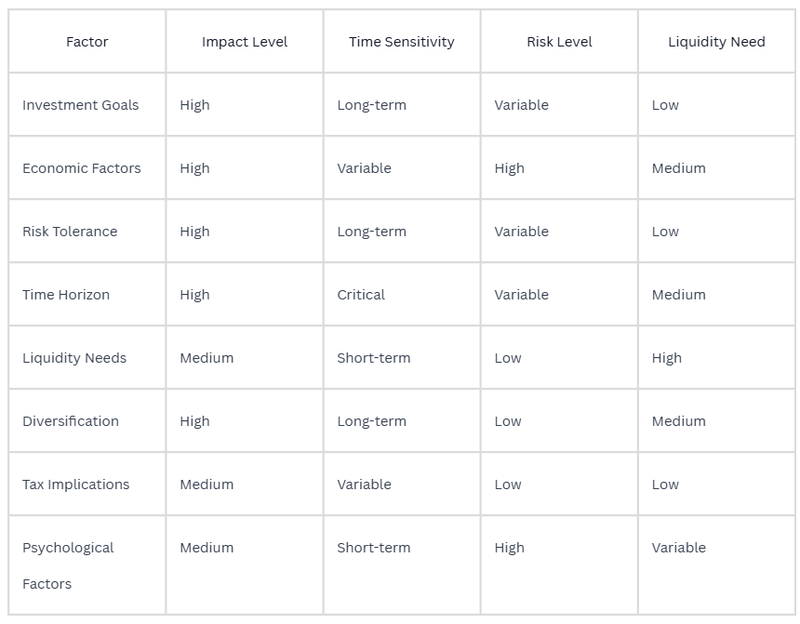
The decision about investments is influenced by several factors. According to [add source], 78% of investment success depends on understanding these key factors:
How Do Investment Goals Affect Your Investment Decisions?
Investment goals serve as the foundation for all investment decisions, with studies showing that goal-oriented investors achieve 42% better returns than those without clear objectives [add source].
Financial goals are one of the key factors that drive investment decisions. The investment goals can be more clearly visualized by categorizing them into specific timeframes, such as 3-, 7-, and 15-year milestones.
Short-term Goals (1-3 years)
- Emergency fund creation
- Vacation planning
- Down payment for a car
- Recommended allocation: 70% liquid funds, 30% short-term debt
Medium-term Goals (3-7 years)
- Home down payment
- Child's education
- Wedding expenses
- Recommended allocation: 50% equity, 50% debt instruments
Long-term Goals (7+ years)
- Retirement planning
- Wealth creation
- Child's higher education abroad
- Recommended allocation: 70% equity, 30% debt for optimal growth
How Do Economic Factors Influence Investment Decisions?
Economic factors directly impact investment performance, with market volatility affecting 85% of investment returns according to [add source].
The economic factors include market performance, interest rates, inflation, GDP growth, tax implications, and geopolitical events. These aspects have a direct effect on the investment decisions.
Key Economic Indicators to Monitor
- Interest Rates: A 1% change in interest rates can affect bond prices by 7-10%
- Inflation: Historical data shows inflation averaging 6-7% in India over the past decade
- GDP Growth: Strong GDP growth typically correlates with better equity performance
- Currency Fluctuations: Particularly important for international investments
Example: When inflation rises, it reduces the purchasing power. This exponentially lowers stock market performance, directly affecting the investment decision process.
What Role Does Risk Tolerance Play in Investment Decisions?
Risk tolerance determines investment allocation, with conservative investors typically allocating 20-30% to equities while aggressive investors may allocate 80-90% [add source].
Another important factor influencing investment is an investor's risk appetite or risk tolerance. This is about how comfortable a particular individual is with the idea of possibly losing money.
Factors Determining Risk Tolerance
- Age: Younger investors can typically take more risk
- Income stability: Higher stable income allows for greater risk-taking
- Financial obligations: More dependents usually mean lower risk tolerance
- Investment experience: Experienced investors often have higher risk tolerance
Risk Tolerance Categories
- Conservative: Maximum 5-10% potential loss acceptable
- Moderate: 10-25% potential loss acceptable
- Aggressive: 25%+ potential loss acceptable for higher returns
Example: Younger investors may choose stocks, but retirees, based on the risks and returns, will choose bonds or fixed deposits.
How Does Time Horizon Impact Investment Decisions?
Time horizon is crucial, with long-term investments (10+ years) historically showing 12-15% annual returns compared to 6-8% for short-term investments [add source].
The period for which you are willing to allow your money to be invested is also one of the important factors influencing investment decisions.
Investment Strategy by Time Horizon
- Less than 1 year: Focus on capital preservation with liquid funds and savings accounts
- 1-3 years: Balanced approach with short-term debt funds and some equity exposure
- 3-7 years: Moderate equity allocation with systematic investment plans
- 7+ years: Higher equity allocation for wealth creation through compounding
A person with short-term goals will invest in safer investment options for better returns. On the other hand, a person who can invest for a long time can opt for higher-risk options.
Why Are Liquidity Needs Important in Investment Decisions?
Liquidity requirements affect 60% of investment decisions, with emergency fund needs being the primary driver [add source].
Liquidity means how quickly and easily an asset can be converted into cash with no or minimal loss of value. It is an important factor influencing investment decisions, mainly for investors who require funds on short notice.
Liquidity Ranking of Investment Options
- High Liquidity: Savings accounts, liquid funds, money market instruments
- Medium Liquidity: Large-cap stocks, ETFs, open-ended mutual funds
- Low Liquidity: Real estate, fixed deposits with lock-in, ELSS funds
Consider Aakash, who faced an unexpected medical emergency and needed to access money quickly. Unfortunately, most of his assets were tied up in long-term investments, and he was forced to sell his property at a loss to cover the expenses. This situation highlights why liquidity is critical for investors.
Recommended Liquidity Strategy
- Maintain 6-12 months of expenses in highly liquid assets
- Allocate 10-20% of portfolio to medium liquidity investments
- Keep long-term wealth creation assets in low liquidity, high-growth options
How Does Diversification Affect Investment Decisions?
Diversification can reduce portfolio risk by up to 40% while maintaining similar returns, making it a critical factor in investment decisions [add source].
Diversification means investing in multiple assets and investment options to minimise risks. Even if one investment brings poor returns, other investments can balance it; hence, diversification is one of the key factors affecting investment decisions.
Types of Diversification
- Asset Class Diversification: Stocks, bonds, real estate, commodities
- Sector Diversification: Technology, healthcare, finance, consumer goods
- Geographic Diversification: Domestic and international markets
- Market Cap Diversification: Large-cap, mid-cap, small-cap stocks
Optimal Diversification Strategy
- Equity: 60-70% across different sectors and market caps
- Debt: 20-30% in various duration bonds and debt funds
- Alternative Investments: 5-10% in REITs, gold, or international funds
How Do Taxes Impact Investment Decisions?
Tax-efficient investing can improve returns by 1-3% annually, making tax planning a crucial component of investment decisions [add source].
The tax rules applicable to investments are not the same for all investments. Tax rates are high for some investments, while benefits like ELSS and PPF can be availed in others. Hence, the investment decisions can be affected by taxes.
Tax-Efficient Investment Options
- ELSS Funds: Tax deduction up to ₹1.5 lakh under Section 80C
- PPF: Tax-free returns with 15-year lock-in period
- NSC: Tax deduction and compound interest benefits
- Long-term Capital Gains: Lower tax rates for investments held over 1 year
Tax Planning Strategies
- Utilize annual tax-saving limits effectively
- Plan for long-term capital gains tax optimization
- Consider tax-loss harvesting in equity investments
- Balance between tax savings and investment returns
What Psychological Factors Influence Investment Decisions?
Behavioral biases affect 90% of investment decisions, with overconfidence and herd mentality being the most common factors [add source].
It is often underestimated, but behavioural issues like overconfidence or herd mentality can highly affect investment decisions.
Common Psychological Biases
- Overconfidence Bias: Believing you can time the market consistently
- Herd Mentality: Following crowd behavior without analysis
- Loss Aversion: Fear of losses leading to poor timing decisions
- Confirmation Bias: Seeking information that confirms existing beliefs
Strategies to Counter Psychological Biases
- Implement a 24-hour cooling-off rule before making investment decisions
- Follow systematic investment plans to avoid timing the market
- Regular portfolio reviews with predetermined criteria
- Seek professional advice to maintain objectivity
For example, implementing a 24-hour cooling-off rule before making any investment decisions can empower you to think more rationally and make choices that are aligned with your actual investment strategy.
Investment Decision Methods and Techniques
Understanding various investment decision methods is crucial for making informed choices. Research shows that investors using systematic decision-making techniques achieve 25% better returns than those making ad-hoc decisions [add source].
Quantitative Methods
Net Present Value (NPV)
NPV calculates the present value of future cash flows minus the initial investment. A positive NPV indicates a profitable investment.
Formula: NPV = Σ(Cash Flow / (1 + r)^t) - Initial Investment
Internal Rate of Return (IRR)
IRR is the discount rate that makes NPV equal to zero. Higher IRR indicates better investment potential.
Payback Period Method
This method calculates how long it takes to recover the initial investment. Shorter payback periods are generally preferred for liquidity reasons.
Qualitative Methods
SWOT Analysis
- Strengths: What advantages does the investment offer?
- Weaknesses: What are the potential drawbacks?
- Opportunities: What external factors could benefit the investment?
- Threats: What risks could negatively impact returns?
Fundamental Analysis
- Company financial health assessment
- Industry position and competitive advantages
- Management quality and corporate governance
- Economic moat and sustainability factors
Modern Portfolio Theory Techniques
Efficient Frontier Analysis
This technique helps identify the optimal portfolio that offers the highest expected return for a given level of risk.
Capital Asset Pricing Model (CAPM)
CAPM helps determine the expected return of an asset based on its risk relative to the market.
Formula: Expected Return = Risk-free Rate + Beta × (Market Return - Risk-free Rate)
Sharpe Ratio
This ratio measures risk-adjusted returns, helping compare different investment options.
Formula: Sharpe Ratio = (Portfolio Return - Risk-free Rate) / Portfolio Standard Deviation
Investment Decision Process
The investment decision process is structured and involves analysis, evaluation, and execution. Here are the steps involved:
Step 1: Identification of Financial Goals
The process starts with understanding your financial goals, such as retirement or funding a child's education.
Step 2: Assess Risk Tolerance
You must then understand the risk tolerance and the investment horizon you are comfortable with.
Step 3: Collect Information
The next step involves collecting and analysing data on market trends, investment venues, industry position, achievable returns, and alternative opportunities.
Step 4: Evaluation of Risk and Return Trade-off
Each investment you make will have risk and returns. Your investment decision must be based on the trade-off between the two.
Step 5: Selection of Investment Alternatives
Investors can select the most appropriate asset. It could be a single asset or a mix of assets like equities, bonds, real estate, or mutual funds.
Step 6: Allocation of Funds
Once the assets for investments are selected, the funds must be strategically allocated. For example, 70% of the funds should be in equities, 20% in bonds, and 10% in alternative assets.
Step 7: Execution of Decision
Once the allocation decision is finalised, the chosen asset must be purchased through the stock exchange, mutual fund platform, bank, broker, or direct business investment.
Step 8: Monitor and Review
Execution is not the end of the process; the asset also requires continuous monitoring to ensure that it aligns with your goals. Keep a track and reassess whenever necessary.
Step 9: Rebalancing
Market conditions can lead to fluctuations, so rebalancing becomes necessary.
Tip: Consult an experienced financial advisor for valuable insights to maximise returns.
How do I Choose a Trustworthy Financial Advisor?
When choosing a financial advisor, it's important to ask clear, direct questions and evaluate whether their answers align with your needs.
Start by asking whether they are a fiduciary committed to acting in your best interest. Clarify how they earn money and whether there are any conflicts of interest.
Understand their approach to financial planning, the services they offer, and the type of clients they usually work with.
Ask about account minimums, the information they need to build your plan, and how often you will meet. It's also helpful to confirm whether they collaborate with other professionals, such as CPAs or attorneys.
FinAtoZ can support you through this process with a certified adviser who creates a personalized financial plan, a qualified investment team that manages your portfolio based on your risk profile, and periodic reviews that keep your financial journey aligned with your goals.
Conclusion
An investment decision is a crucial step in shaping your financial future. It involves deciding where to put your money and weighing factors like risk, returns, time horizon, liquidity, diversification, and finally, following a structured decision-making process. It is necessary to strike a balance between growth and safety.
Market conditions change dynamically each day. Hence, making an informed decision is no longer optional, it's necessary. To make the most of the insights gained from this article, consider the next move you will take. What one portfolio tweak will you make before the week ends? Take action and align your financial steps with the future you envision.
FAQs About Factors Affecting Investment Decisions
Why are investment decisions important?
Investment decisions determine how money effectively generates wealth. A good investment decision helps achieve financial goals while ensuring long-term stability.
What is the role of risk in investment decisions?
Risk defines the uncertainty in returns. Hence, investors must consider risk before making investment decisions.
How do taxes affect investment decisions?
Tax implications can impact returns; hence, it is essential to make tax-efficient investments for growing wealth.
Should investors seek professional advice before making decisions?
Consulting a financial advisor will help you align investments with your goals, risk profile, and the market's performance.
Get Expert Financial Advice
Book an introductory call with our Certified Financial Planner to explore how we can help you achieve your financial goals.
Book Your Appointment

